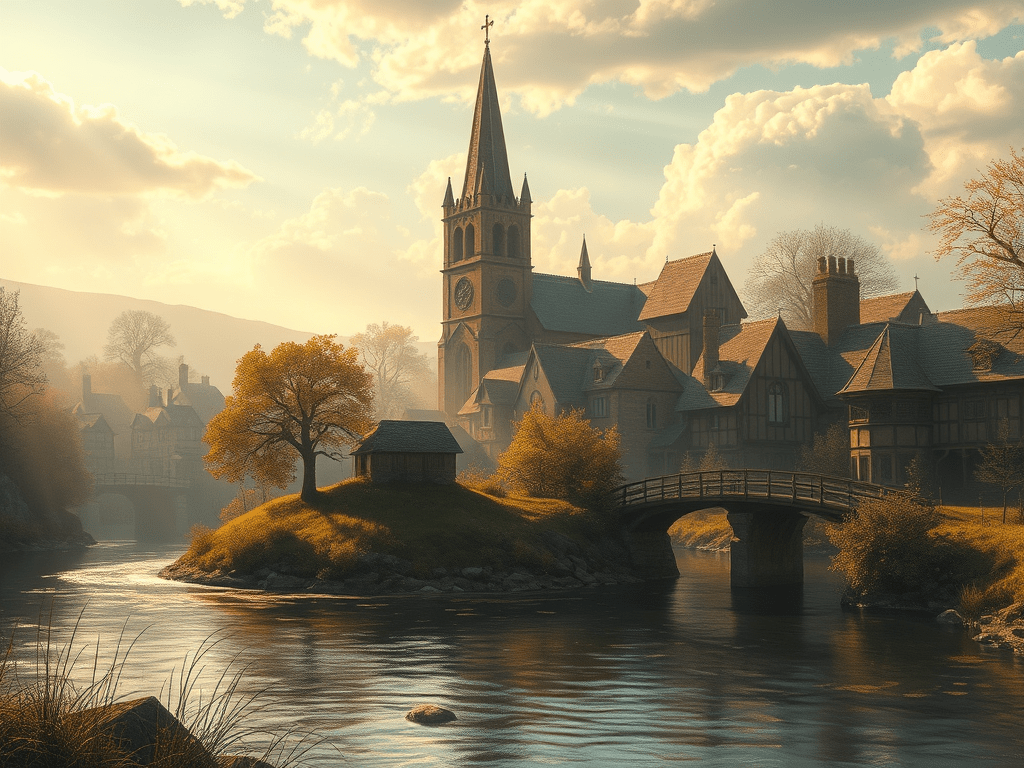
A review of the sequel to The Pillars of the Earth. Image credit: artificially generated.
Kingsbridge again. A different century this time, though. We witness a maelstrom of greed, love, hate, and tension play out.
Follett is masterfully skilled at weaving a story that spans decades and yet somehow maintains interest and currency at every moment, feeling like a connected whole. Maybe this is helped by his writing style. He himself has described it as transparent, “windowpane” prose – what you see is what you get. You’re not really going to have to guess with Follett’s writing, or read too much into it. But that’s part of the charm. Sometimes, you just want to see a good old yarn spun out, and that’s what Follett gives you. You’re never detached and always in the thick of things.
I read this because I loved The Pillars of the Earth and wanted to escape to that place in a magical period of history once again. I wanted to experience more of the same. This didn’t disappoint in that regard. The story was in many ways quite similar to Pillars, featuring some the same archetypal personalities and behavioural patterns, though with some differences, additions, and complications to the previous relationship dynamics. In Pillars we had Jack, Aliena, and Prior Philip. Now we’ve got Merthin, Caris, Godwyn, and Philemon, among others. And though some aspects did inspire a sense of déjà vu, the writing felt sufficiently fresh on the whole while still maintaining the same Kingsbridge character.
Though a brilliant novel, there were a few things which did make me raise an eyebrow. Ralph – Merthin’s brother, for example, makes some interesting decisions. Some of his character development and behaviour seemed a little unexplained and surprising – to say the least! This manifested in other characters too, who to my occasional confusion (though also, I must say, guilty delight when ensuing drama played out) wantonly decided to momentarily forget that their actions have consequences.
Regarding the way the book concluded, I did feel it all happened rather quickly. And worse, infuriatingly, it seems some secrets may remain hidden indefinitely to those characters to which they matter most. I’m not sure I’m happy about that, but maybe that’s just how life is sometimes.
This was a very long book, perhaps necessary to account for (and justify) the length of time it covered. By the time you do get to the end, it does feel like you’ve lived a good while. Indeed, you can treat the book as you would treat real life: sometimes there are lulls in the action, sometimes days go by and you begin to wonder “where is this going?”, but eventually things come to a head and a few moments completely change and turn the story’s direction. Maybe those lulls add to the realism and emphasise the meaningful bits.
The attention to historical detail throughout greatly enhanced the reading experience. The careful knitting of the story into its historical context involving real rulers and rivalry, the careful choice of words, people’s choices of actions, the attitudes of the characters to life. All of this helps to transport you to a world which feels rich, colourful and real.
This is the second in the Kingsbridge series that I’ve read, but it certainly won’t be my last.






 Thoughts of Geresy
Leave a comment