I was watching a video recently where Ralph Allwood – former director of music at Eton – claimed that we shouldn’t be worrying about “classical” music. Rather, he suggested that we should be concerned with good music. The greatness of music does not depend on when it is was written. He used the example of Yesterday, by the Beatles, to illustrate the point. Yesterday has a special place in my heart – it had a deeply moving effect on me when I heard it for the first time around 15 years ago, and it has done for a long time since, as a result of both its bittersweet lyrics and hauntingly beautiful tune.
But why then is there a category of music – not to confuse it with the music of the “Classical” period, that is confusingly a sub-category of historical music – called classical music? And why does that music have something of a reputation for being thought of as superior to more modern music?
The answer has two complementary angles, one simpler and the other more nuanced. The first is straightforward – survivorship bias. To put it simply, classical music is music that has survived the test of time. When something sticks around for a long time, it’s usually because it’s been judged as good by not just the people alive today, but generations of people beforehand, who have liked it, found something meaningful or beautiful in it, and consistently passed it on for its emotional or artistic value. The second, more subtle point, is that the pieces of music in the classical repertoire are those that defined the evolution of music as a field. What we know as the field of music today is the product of centuries of experimentation, playing, and development by musicians long since dead. Let’s look at each of these points more closely.
Firstly, there is survivorship bias. Not all music that was written in the past was good by default. There are many lesser known and lesser played pieces that composers write, and they’re lesser for a reason – they just didn’t make the cut. The only reason they might still be played today is out of historical interest. If you think of your favourite pieces of music, some of them will be pieces that you heard recently, because they are good in the context of what you know now. In contrast, other pieces will be those that you have known for many years. The past has a numbers advantage; it’s simply got many more pieces of music by virtue of it spanning a much longer stretch of time than that which we might consider the “present”. As such, if we were to sample the goodness of pieces of music among the best in a batch, the past wins purely based on sheer quantity.
Coming to our second point, the past also has the advantage because music isn’t some kind of abstract, dry, Platonic ideal of perfection that we strive to match. Rather, like any human-defined field, it is a moving, growing matter that stretches, squeezes and warps to accommodate the input of successive generations of musicians. Music is not a container that pieces and songs either fall into or don’t, rather it is defined by whatever we produce. Just as fashion choices change with the season, the year, and the decade; just as the popularity of activities, of ways of speaking, of worldviews, shift and change with time, so does music and what we think of as music. The key point is that what we have now is not independent of what we had then, but a product of it – built on top of it. It could not exist outside of a historical context that gives it meaning.
The musical palette that we have today is by no means the same as it was many years ago. It has been shaped by the creative choices of musicians of the past, by the theorists who have carefully carved out the basis for our liking of music, and continue to revise their opinions of it as times evolve (interestingly, it was recently discovered that we actually tend to prefer notes that have a slight “off-ness” about them), and the exercises that influence budding young musicians (think major/minor scales and arpeggios, and a relatively modern minimalist musical trend of stripping down the complex palette to just a few chords to signify strong, essential emotions). What others have created before us shapes what we know and use, what we are familiar with, and consequently what we might consider “fresh” music – a freshness that can only be understood as ripples on the surface of the language of the vast musical library that humanity has been building for so long.
Though there is always a drive towards novelty, there remain pieces of music that can still move us, and that touch at the very threads of what make us human, hundreds of years on. These are the pieces that form the classical “repertoire” – those pieces of music most frequently played and that are illustrative and defining examples of particular techniques and ways of forming music. They are the directions that those before us picked from the works of those before them, in spite of their preference for novelty. They are works that have been passed on time and again, because they have struck at something universal and deeply profound.
Take the simple joy of Bach’s Goldberg variations or Brandenburg Concertos, the operatic intensity of Handel’s Messiah, the rousing power of Sibelius’ Finlandia, the heights that Vaughn Williams’ sublime Lark Ascending takes us to, the colourful images painted by Holst’s The Planets and the energy of his St Paul’s Suite. All these works can move us and carefully tune and play with our emotions, despite having been written by individuals who have lain still for years (sometimes centuries). That in itself is a miracle. But it’s also because those musicians were not only writing to conform, but writing to define, often unknowingly. They were the influencers of their time, and they are still influencing us today, whether we are aware of it or not.
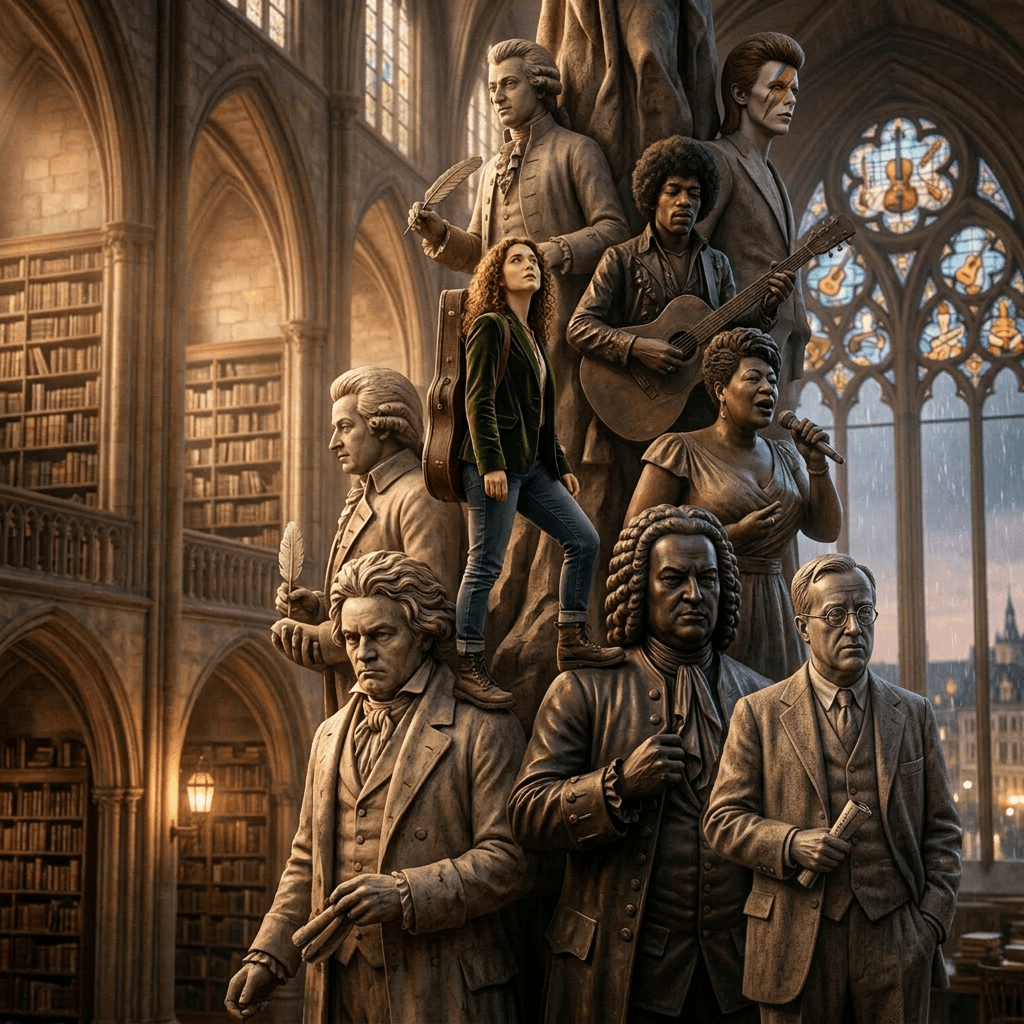
We stand on the shoulders of giants when we create new theories in physics, or indeed do research in any scientific field. We are never starting from scratch, but building on the work and ideas done by those before us. The carefully constructed tower has foundations that were chosen long ago and continue to influence us today. The theory of relativity wouldn’t have been possible without the classical laws of motion to precede it.
The great musicians are great because they influence every part of music creation today. They broke ground and produced the first examples of certain techniques, showed us what was possible, expanded the frontiers of music. Their work lives on in the very essence of our musical thought.
For music made today to be popular, it need only appeal to the latest trends and fashions and be current, such that it can be understood in the context of a particular time and place. The threshold for appeal is much lower for modern music to be temporarily successful. Great music is that which transcends the boundaries of time and space and exists without it. If a piece of music is capable of surviving the test of time and says something universally comprehensible about the human experience, then it is great music and will be afforded a place in history by the countless generations who hear it and vote with their ears.
Already, the sun is setting on the era when Yesterday was written (the sixties). Yet the music lives on, through its presence in our hearts and minds, and its influence on scores of scores. Yesterday is a good candidate for the classical music of tomorrow. Whether it will still be popular in 200 years isn’t necessarily testament to its adherence to any objective measure of perfection, but to our generations and the ones after us finding something timeless and universally human in its notes and words and passing it on. In doing so, we and they will decide what defines both music and us as human beings. Perhaps one day, hundreds of years from now, a likeminded soul will once again hear the same notes as we do now. In that instant, a bridge will form for a moment, marrying the past and the future, lighting up the foundations of the musical repertoire. It will illuminate something about what really defines us as human beings – our own choices – and the self-determining path we weave through time. Our destiny.
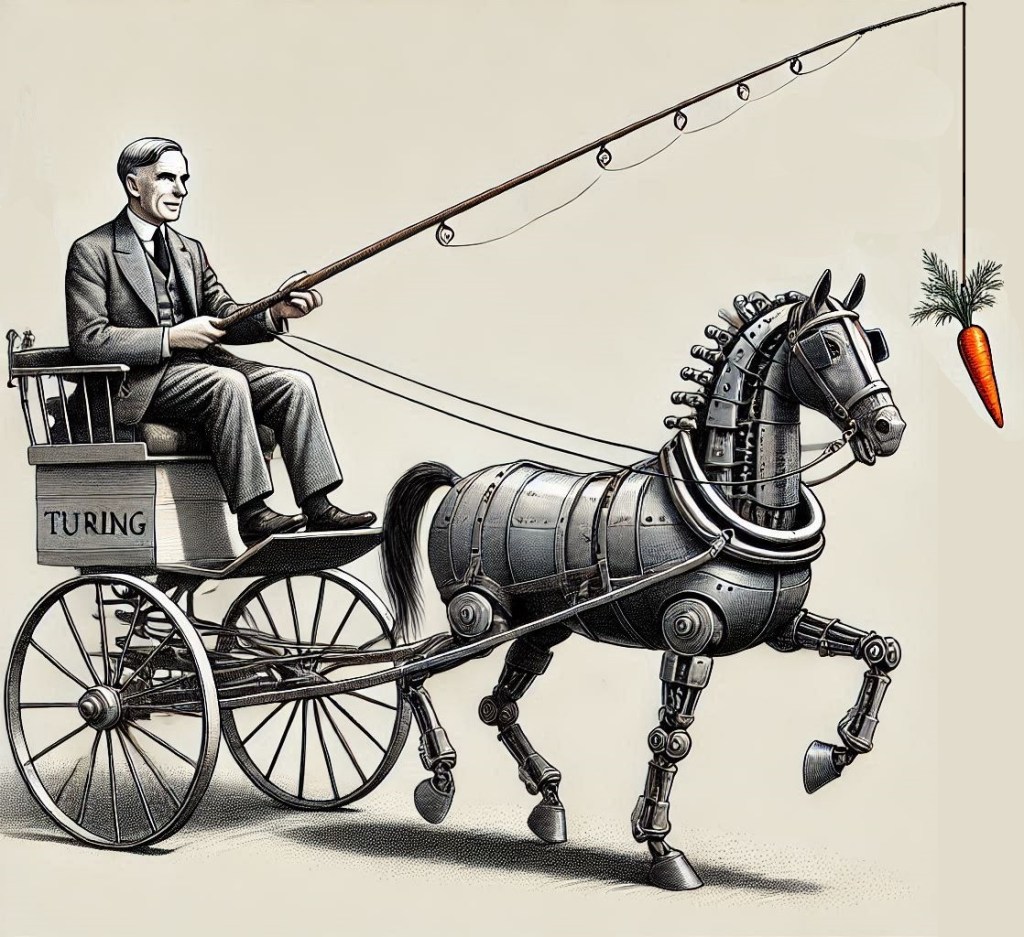
Image credit: AI generated based on prompting by me. We stand on the shoulders of musical giants, like Bach, Holst, and even more recent artists such as David Bowie, whenever we compose or even experience music. Everything is framed through the lens that they have built up for us.






Leave a Reply