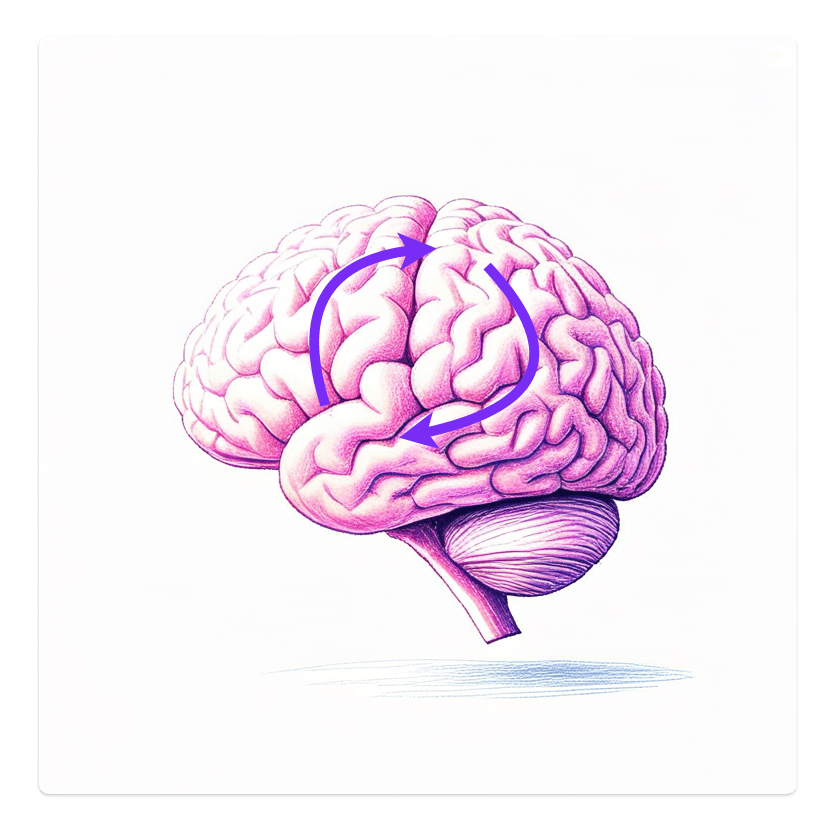
Is the mystery of consciousness an illusion that we convince ourselves of to help us survive?
The incessant need to ask questions is a defining feature of human beings. Although we ask ourselves many different questions on a daily basis, if one really thinks about it, all these questions ultimately resolve to the same fundamental axiomatic conundrum: the mystery of existence.
I recently heard that if one chooses a random Wikipedia page and clicks the first link to take them to a new page, then does the same on the page they end up on, and so on, then they will inevitably end up on the page for Philosophy. Upon trying this out myself, I found this to be mostly true. Apart from its value as a mildly interesting dinner party conversation starter, at a deeper level, it points at the fact that our daily life experience is rooted in a fundamental philosophical mystery: the existential question that asks what reality is. Once we realise this – the fact that all roads of knowledge lead to the city of philosophy doesn’t seem so strange after all. We are obsessed with the same mysterious question posed from different angles: What is this place? Who are we? Why are we here?
As many great – and indeed, many not so great (well-known) – philosophers have posited, perhaps most famously Descartes, the only thing that we can be sure of is the reality of our own experience – the fact that we are at any one time having an experience. We cannot necessarily trust that the information delivered to us by our senses is objectively true, or that our beliefs about reality are in any way accurate or consistent, but we can trust that we are experiencing something at the very least. At a fundamental, logical level, we must accept this in order to avoid drowning in a sea of contradiction and paradox. So ultimately, all philosophical questions resolve to the same knotty root: the mystery of being here and experiencing this, whatever this is.
I shall refer to this unspoken bundle of paradox as the mystery, and the mystery rears its head almost everywhere, if you look hard enough. Film, books, the foundation of religion and the belief in a higher power, all hint at or explicitly relate the mystery. We cannot escape it. Perhaps most clearly and obviously, it is spoken about by those interested in philosophy of mind, in which domain it is known as (the problem of) consciousness, and particularly the hard problem of consciousness.
The elusive nature of this mysterious question is precisely what has made it so enduring and bestowed it with the special status it has acquired in the minds of millions, inspiring all sorts of ideas – whose truth aren’t the subjects for debate here – about magic, monsters, the divine, and the supernatural. In Sentience, Humphrey isn’t around to argue the toss about which of these ideas or perspectives is correct or seemingly even to address the knot at all. He wants to look at the question from an evolutionary perspective. He does so in two ways.
The first is by creating a straightforward, plausible story about the evolution of sensation through the experience of what are known as qualia – the term for subjective sensory experiences. Humphrey’s story goes as follows: historically, primitive organisms developed an ability to sense their environment and respond in particular ways that enabled them to condition their behaviour (instantaneously) on the environment around them. For example, wriggling “redly” (to escape, or move towards, colours of light that might be associated with danger or safety), thrashing “saltily” (to come closer to potential sources of nutrition), or curling up “coldly” – you get the picture. He argues that the next step – because anything that evolved needs to have a stepwise path (most vividly, perhaps, the evolution of the eye) – is for the reflexive response to become internalised – to impact a world model. The third step is for an internal observer to monitor the response (phenomenal sensation). Finally, comes that necessary appeal to the unanswerable and the implicit and delayed sweeping under the carpet of the philosophical baggage: the response becomes recursive and eats its own tail, forming strange “high-dimensional” “attractor states” of unknowable and immense potential complexity. So, the mystery endures. Thus, though the story itself is plausible and pleasing from a logical evolutionary perspective, it does not – and perhaps was not intended to – answer the philosophical question it may have fooled readers into thinking it might based on the title of the book. If you were looking for answers to unanswerable questions, sorry to disappoint.
The second, perhaps more interesting line of evolutionary reasoning, that Humphrey takes in this book is of again sidestepping futile attempts at reductive explanation of the mystery and instead asking the beautiful question of what the role of the mystery is from a survival perspective. He argues that being beings endowed with this mysterious nature – or at the very least believing as such – allows us to bestow upon our “selves” a special, magical status, that makes us value them for their rarity and therefore wish to preserve them. In short: the mind has been designed by evolution to induce upon itself a riddle that is confusing and answerable by its very design, to ensure that the self is afforded a special and valuable status that encourages us to preserve it at all costs (a drive to survive). The argument is straightforward, but its implications profound. It implicitly suggests that questions themselves are human constructions and that the answers that we seek may sometimes be hidden from us by our very minds, or even fundamentally non-existent paradoxes inescapably built in to our framing of the world around us. If we are capable of unknowingly convincing ourselves of the potential answerability of something that is fundamentally not so, and suspending ourselves in a state of perpetual existentialist confusion, then the nature of understanding itself takes on a very different light.
Whether this magic and mystery of consciousness is “real” is a moot question. What is real is what we believe. What is magic is what we don’t understand, by definition. Humphrey makes the bold claim that perhaps the problem of consciousness is a unanswerable riddle of our own making. Perhaps that is – and defines – magic. Sentience puts forward an incredibly fascinating perspective. I’m sure that it will form part of the fabric of philosophy that continues to be woven day by day, driving forward exploration and investigation into the fundamental nature of reality and the conscious self, whether that be to a definite satisfying philosophical end, or just a means to promoting our survival. How much longer the survival of our species as we know it is itself guaranteed, given the unfettered progress of AI, is a very different question with a very different and perhaps equally critical kind of existentialist consequence. Let us hope that whoever is in charge of our world 100 years from now can still experience the philosophical delights of being completely stumped and can continue to place value human experience as a result.









 Charges of Geresy
Leave a comment